Have you ever fought and struggled and ripped and re-ripped both your yarn and hair, trying to make your starting round neat and tidy with a center hole as small as possible? Of course you have. And maybe, just maybe, that unsightly center hole has even kept you from crocheting in the round at all. Well, no more. Now you will be armed with the trusty (some might even say magic) adjustable ring and you will be dancing circles around those circles.
Be forewarned—once you have made an adjustable ring, you will never be the same. You may never go back to other ways of making a ring. I know I haven’t. There are a lot of photos. But don’t worry; you’ll be sailing through this in no time. For the sake of knowledge (we can never have too much of that, can we?) I will also show you the two more commonly known ways of starting a round, first, joining a chain to form a ring, and second, crocheting into the first chain.
This tutorial assumes you know how to chain, slip stitch, and double crochet. For demonstration purposes, each of these three beginning rounds has 15 dcs worked into the center, plus the first ch-3 (which counts as the first dc) equals 16 dc.
US pattern notations used.
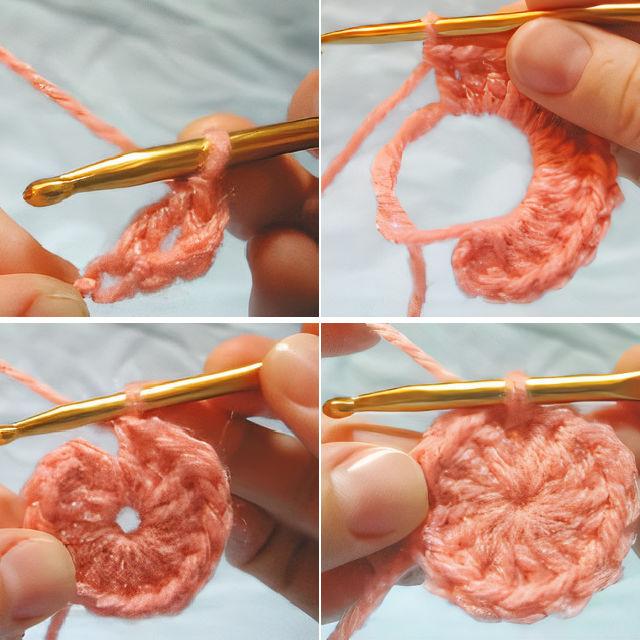
Make a large loop by putting the yarn tail behind the working yarn (the yarn coming from the skein) (Figures 1-2), leaving at least a six-inch tail until you become familiar with this method (Figure 3). Later, you may leave a shorter tail if desired.
With your hook, draw the working yarn through the loop, so you have one loop on the hook (Figures 4-6).
Ch 3 (counts as first dc) (Figure 7).
How you hold the loop while you work the stitches into it is personal preference, but I find it convenient to put both my pinky and ring finger inside the loop to hold it tight (Figure 8.)
Dc into the loop, crocheting over the tail (Figure 9). Continue to work as many dcs as needed for you pattern into the loop. (Don’t forget to keep crocheting over the tail.) When you are finished working stitches into the loop, you will likely find that the tail has curled around the loop a few times (Figure 10). To make it easier to draw the loop closed, first untwist the tail (Figure 11); then pull the tail to draw the loop closed. You can leave an open hole in the center (Figure 12) or draw it closed very tightly (Figure 13).
Ch 4 (Figure 1). Join to fourth ch from hook (the first ch made) with a sl st to form a ring (Figure 2). Ch 3 (counts as first dc) (Figure 3). Dc into ring (Figure 4). Continue to work as many dcs as needed for your pattern into the ring (Figure 5). Join with a sl st into the third ch of the ch-3.
Ch 4 (chs 2-4 count as first dc) (Figure 1). Dc into the fourth ch from hook (the first ch made) (Figures 2-3). Continue to work as many dcs as needed for your pattern into the same ch (Figure 4). Join with a sl st into the fourth ch of the ch-4.
Hi Donna - I've just joined today. Your tutorial looks like a very valuable one, but none of the pictures come up. Is it possible to relink them, or do you have it as an MS Word document or PDF file? I found it because a Ravelry person mentioned it. I'd be grateful for any info.
Regards,
Linda "K"
Thank you for the information Donna. I am with Linda “K”, the pictures did not come through. Can you try to send again? Thanks!!!
Donna--I have just joined today! I would love to know the magic circle method, but alas, I am a picture gal and your pics haven't come through. Thanks for your tips and help!!
Hi Donna, I, too, have just joined today. I am so excited to find a site like yours. I have been crocheting for approximately 25 years and I never have found a site like yours, explaining directions so that I don"t skip projects that I did not understand. Thank you, Karen
Copyright (C) 2010 Interweave Press, LLCUse of this site signifies your agreement to the Terms and Privacy Policy, updated March 2007